System overview
Docker images are used to encapsulate the software libraries and dependencies required by HistomicsML2. This enables containers derived from these images to be deployed on a variety of platforms ranging from Macbooks to GPU-enabled linux servers. A graphical overview and description of these containers is provided below.
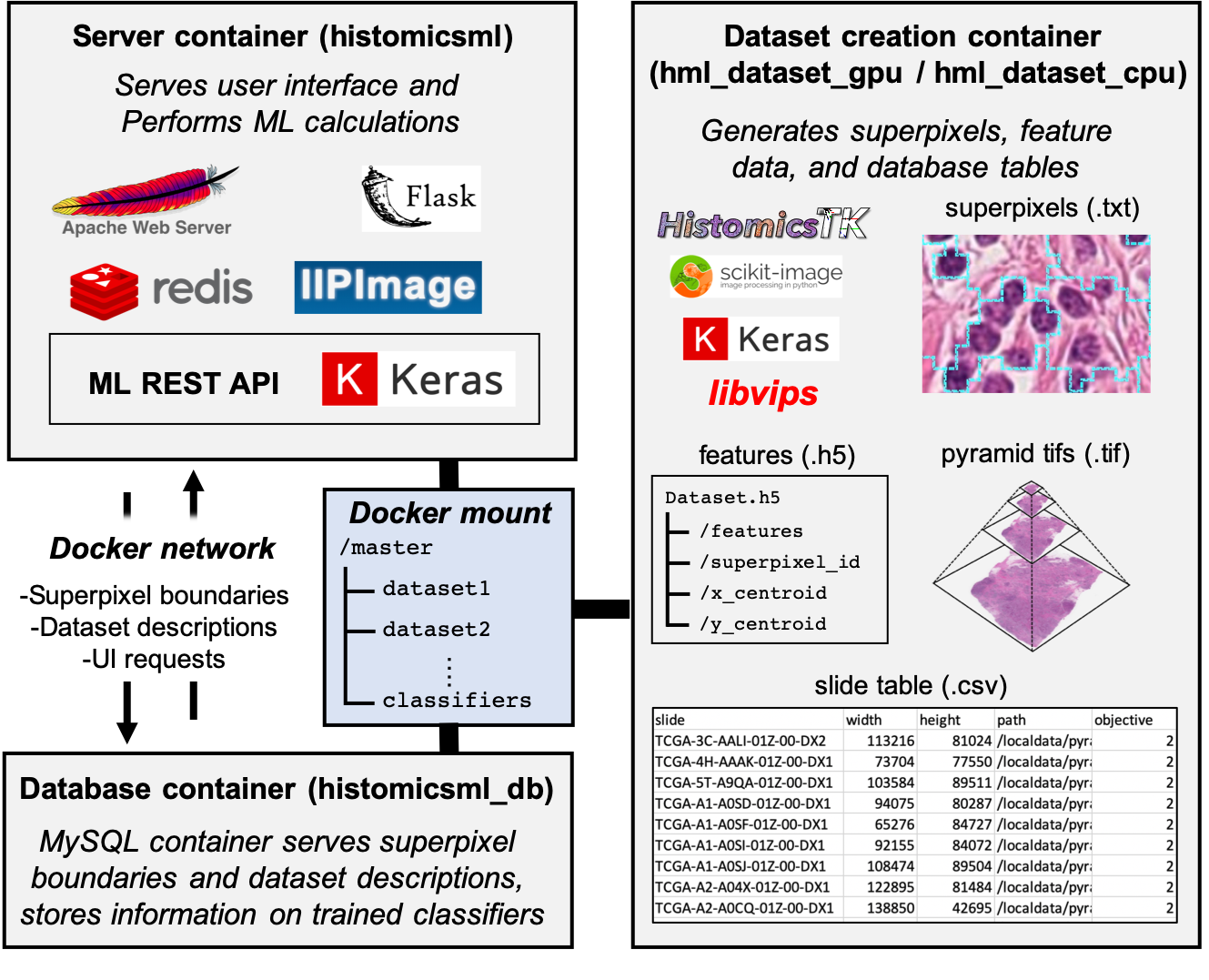
- Server container
The server container hosts the user interfaces of HistomicsML2 and performs the machine learning training and inference. Apache serves the UIs with IIPImage enabling navigation of multiresolution whole-slide images inside the web browser. Flask and Keras are used to implement a machine learning REST API so that machine learning models can update as users label data and provide feedback. Redis is used as a data store for user inputs and intermediate results throughout a training session. A GPU-enabled version of the server image is available to accelerate real-time training and prediction.
- Database container
The MySQL database container stores superpixel boundaries, information about datasets, and records of training sessions.
- Dataset creation container
The dataset creation container allows users to convert their whole-slide images to HistomicsML2 datasets. HistomicsTK, Scikit-image, and Keras are use to perform segmentation and feature extraction on whole-slide images. libvips is used to perform conversion of proprietary whole-slide image formats to pyramidal tifs required by VIPs. A GPU-enabled version of this container is built using the NVIDIA docker to accelerate feature extraction.
- Docker network
This network enables communication between the server and database containers. While users navigate whole-slide images the server container renders superpixel boundaries by making requests over the network. Dataset and classifier selection fields are also populated from requests by the server container.
- Docker mount
Files from the local file system are mounted inside the docker containers, allowing the containers to consume data and to write results back to permanent storage. A single master folder contains subdirectories for each dataset, and a directory to store trained classifiers. This folder is mounted by all containers.